How Claude Is Changing Web Design in 2026
AI didn’t replace web designers. It made the good ones dangerously fast.
If you’ve been paying attention to the web design industry in 2026, you’ve noticed something shift. Projects that used to take 8 weeks now ship in 3. Designers who once juggled Figma, code editors, and content docs separately now move between all three in a single workflow — with Claude sitting in the middle.
I’ve shipped over 120 websites across WordPress, Shopify, and Next.js as a vibe developer who uses AI at every stage. In the last year, Claude has changed how I approach nearly every stage of a project. Not by replacing the craft — by compressing the boring parts so I can spend more time on the parts that actually move the needle for clients.
Here’s what’s actually happening, what’s overhyped, and what it means if you’re planning a website project this year.
What Claude actually does in a web design workflow
Claude isn’t a design tool. It doesn’t open Figma or drag elements around a canvas. What it does is handle the cognitive overhead — the thinking, writing, debugging, and decision-making that eats up 60% of a web project’s timeline.
1. Content-first design (finally possible)
The biggest bottleneck in web design has always been content. Designers build beautiful layouts with lorem ipsum. The client sends real copy three weeks late. It doesn’t fit. Everyone scrambles.
Claude flips this. Before I touch a single wireframe, I use Claude to:
- Draft page-by-page content outlines based on the client’s brief
- Write first-draft copy for every section — headlines, body, CTAs
- Generate SEO-optimized meta titles and descriptions
- Structure FAQ sections based on actual search queries
The result: by the time I open Figma, I’m designing around real content, not placeholders. The layout works because it was built for the actual words.
2. From wireframe to working code in hours, not days
Here’s where Claude gets genuinely impressive. I can describe a layout — or paste a screenshot of a wireframe — and Claude will generate production-quality HTML, CSS, and JavaScript.
Not “demo quality.” Not “you’ll need to rewrite this.” Actual code that ships.
For a recent Next.js project, I went from a rough sketch to a fully responsive hero section with animated trust badges, lazy-loaded WebP images, accessibility-compliant markup, and mobile-first responsive breakpoints. Total time: 45 minutes. That same section used to take half a day.
3. Responsive design debugging
Every web designer’s nightmare: the layout looks perfect on desktop, breaks on tablet, and completely falls apart on a specific Android phone. Claude handles this differently than traditional debugging.
Instead of manually testing breakpoints and tweaking CSS, I describe the issue — “the hero image overlaps the CTA button on screens between 768px and 1024px” — and Claude identifies the exact CSS conflict and writes the fix.
For WordPress themes, it can navigate the template hierarchy, find the relevant PHP partial, and suggest changes that don’t break other pages. For Shopify, it understands Liquid templating well enough to modify theme sections without corrupting the JSON schema.
4. Speed optimization that used to require a specialist
Core Web Vitals optimization used to be a separate engagement. Now it’s part of every build.
Claude can audit a page and identify render-blocking resources, rewrite JavaScript to defer non-critical scripts, convert image pipelines to next-gen formats (WebP, AVIF), optimize CSS delivery (critical CSS inline, rest deferred), and identify and fix Cumulative Layout Shift issues.
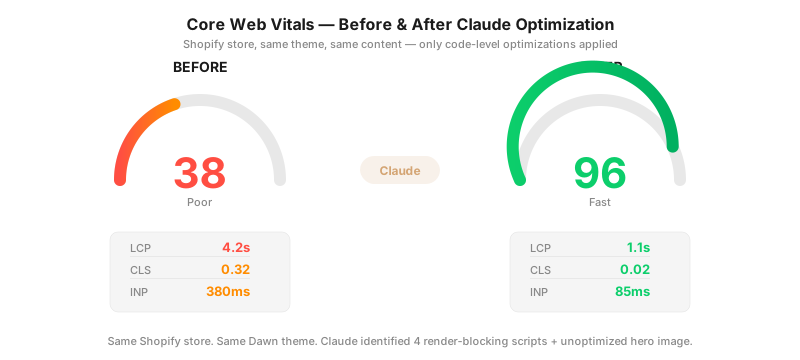
I recently optimized a Shopify store’s Largest Contentful Paint from 4.2s to 1.1s in a single session. The fixes were surgical — Claude identified exactly which theme snippets were causing the delay and rewrote them.
5. Accessibility as a default, not an afterthought
WCAG compliance used to be something you bolted on at the end (or, honestly, skipped). Claude builds it in from the first line of code:
- Semantic HTML structure (proper heading hierarchy, landmark roles)
- ARIA labels for interactive elements
- Color contrast checking against WCAG AA standards
- Keyboard navigation support
- Screen reader-friendly alt text generation
This isn’t a nice-to-have. ADA lawsuits against websites are up 300% since 2020. Claude makes compliance the path of least resistance.
What Claude can’t do (and what that means for hiring)
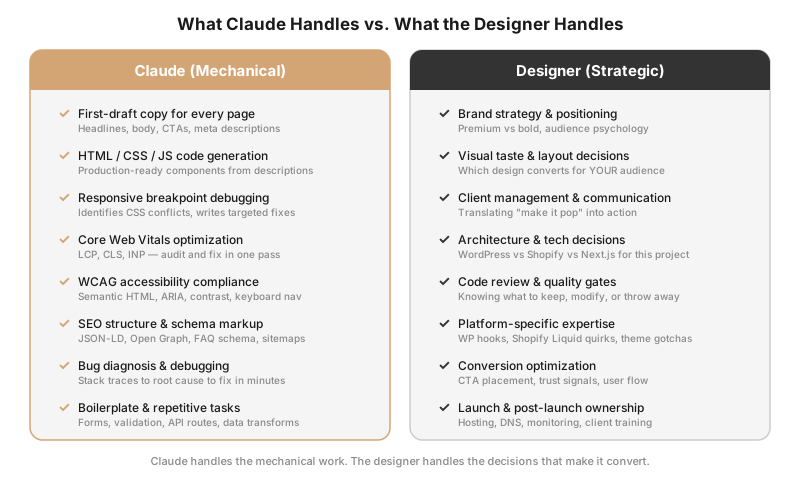
Let me be direct: Claude doesn’t replace a web designer. Here’s what it genuinely can’t do:
Brand strategy. Claude can’t tell you whether your brand should feel premium-minimalist or bold-and-playful. It can’t read a room of stakeholders and figure out what they actually want versus what they say they want.
Visual taste. It can generate code for any layout you describe, but it can’t tell you which layout will convert better for your specific audience. That’s experience, not computation.
Client management. It doesn’t sit on calls, manage expectations, handle scope creep, or translate vague feedback (“make it pop”) into actionable design changes.
Platform-specific gotchas. Every WordPress theme has quirks. Every Shopify store has apps that conflict. Claude helps debug these, but knowing which plugins to avoid, which theme hooks are reliable, and how to structure a store for long-term maintainability — that’s hard-won expertise.
How I use Claude in my workflow (the honest version)
I’m not going to pretend every project is 100% Claude-assisted. Here’s the real breakdown:
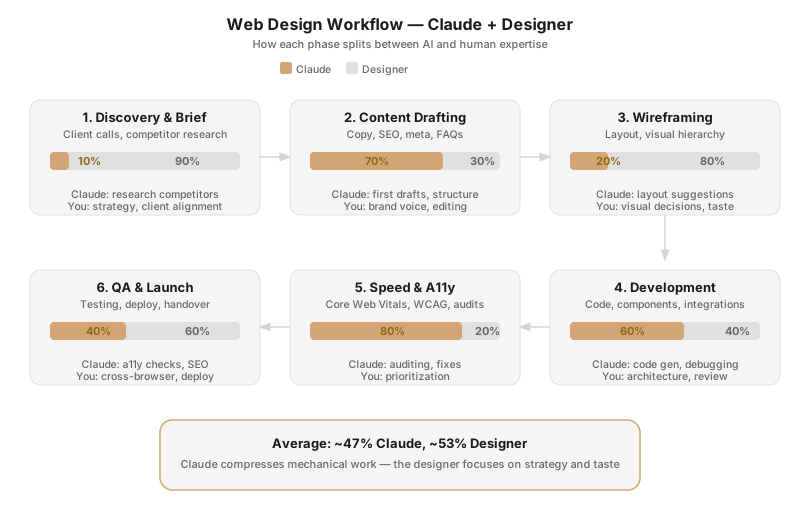
The percentages shift per project. A content-heavy WordPress site leans more on Claude for writing. A custom Next.js app leans more on Claude for code generation. A Shopify migration barely uses Claude at all because the bottleneck is data migration, not design.
What this means for your next website project
If you’re hiring a web designer or developer in 2026, here’s what’s changed:
Timelines are shorter
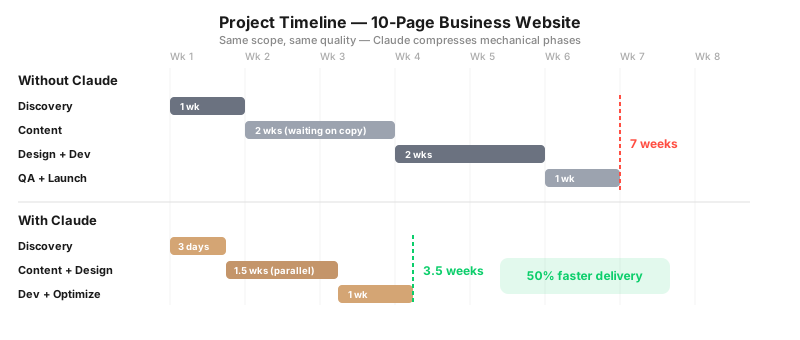
A project that would have taken 6-8 weeks in 2024 can realistically ship in 3-4 weeks now — without cutting corners. The design and development phases compress because the designer spends less time on mechanical tasks.
Quality floors are higher
The baseline quality of a professional website has gone up. Accessibility, performance, SEO-optimized content — these are table stakes now, not premium add-ons. If your designer isn’t delivering green Core Web Vitals scores by default, they’re behind.
Content is no longer the bottleneck
First-draft content can be generated alongside the design, refined with your input, and finalized before launch. No more “waiting on copy” delays.
The designer’s experience matters more, not less
Here’s the counterintuitive part: when the tools get powerful, the person using them matters more. A junior designer with Claude produces faster mediocrity. A senior designer with Claude produces faster excellence.
The tool amplifies whatever skill level you bring to it. Eight years of shipping websites means I know which Claude suggestions to keep, which to modify, and which to throw away entirely.
The bottom line
Claude didn’t make web designers obsolete. It made the gap between good designers and great designers wider.
If your current designer is still quoting 8-week timelines for a 10-page site, still delivering without Core Web Vitals optimization, still sending you lorem ipsum mockups — they’re working like it’s 2023.
The designers who adopted Claude early are shipping faster, charging for results instead of hours, and delivering websites that perform better out of the box.
I’m one of them. 120+ shipped projects, Fiverr Millionaire ($1M+ in orders), and every build in 2026 ships with Claude in the workflow.
Ready to build? Get a quote — scoped, fixed-price, ships in weeks. Or WhatsApp me directly if you want to talk through your project first.
Related: WordPress website design · Shopify website design · Next.js development · Core Web Vitals optimization