Website Design Cost in USA 2026 — Full Pricing Guide
Real price tiers for a US business website, the factors that move the price, and the hosting, domain and maintenance costs that come every year.
Website design cost for a US small business is usually a few thousand dollars to build, plus a yearly bill for hosting or a platform plan, a domain and maintenance. A simple 5-page site sits at the low end. An online store, a membership site or custom integrations push it into five figures. The exact number depends on four things: how many pages and features you need, who designs it, whether your content is ready, and who builds it.
I’m Zain Saeed, a WordPress and Shopify developer. I’ve been building websites for 8+ years and won Fiverr’s Millionaire Award for $1M+ in orders. Below is what decides the cost, the running costs you should plan for, and how to compare quotes.
In this guide
The short answer
There is no single US price for “a website”, because two sites with the same page count can need very different work. What you can do is put your project into a band before you talk to anyone:
- Small brochure site (up to 5 pages): home, about, services, contact, maybe a blog. Usually the cheapest professional build.
- Larger marketing site (6–12 pages): more service pages, location pages, case studies, conversion tracking.
- Online store or membership site: products, cart, checkout, payments, account areas. This is where cost jumps.
- Complex builds: large catalogs, B2B pricing, ERP or warehouse integrations, headless front ends, several languages or currencies.
Then add the yearly running costs (covered below) so the number you budget is the real one, not just the launch invoice.
How I quote and how long it takes
I do not publish fixed price lists, because two projects with the same page count can need very different work. You send a short brief, and I reply with one fixed price agreed before work starts, so the number does not grow with the hours.
| Type of project | Usual timeline | What it covers |
|---|---|---|
| Small brochure site | 2–3 weeks | Up to 5 custom pages, custom WordPress theme, basic SEO, contact form, analytics setup |
| Larger marketing site | 3–5 weeks | Up to 12 pages, reusable page sections, schema, newsletter, conversion tracking |
| Online store or membership site | 5–8 weeks | WooCommerce or Shopify store, or a membership or course site |
| Complex build | 8–14 weeks | Shopify Plus B2B, headless builds, ERP or 3PL integration, large migrations |
What your project costs depends on the drivers in the next section. If you want to know what a fixed price should and should not include, I explain that in what to expect from a fixed-price website project.
What makes a website cost more or less
Number of pages and templates
Pages are not priced one by one. Setup, hosting, the design system and the first few templates are the fixed part of the work. After that, a new page built from an existing template is cheap, while a page that needs its own new layout costs more. Ten service pages that share one layout cost far less than ten unique pages.
Who designs it
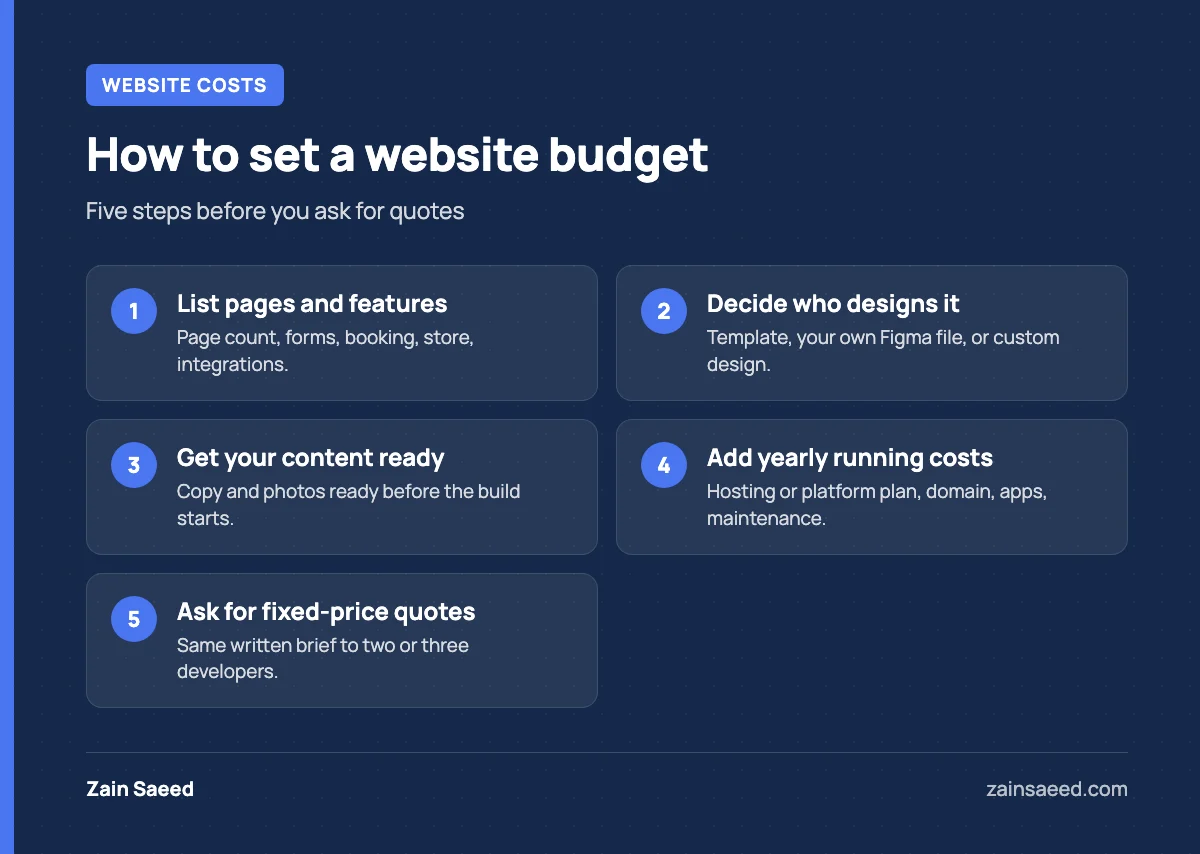
- Template with your branding: the cheapest route. Fine for many service businesses.
- You bring a finished Figma design: the developer only builds, so the build cost drops.
- Custom design from scratch: more rounds of work and feedback, so more cost and more time.
Features and integrations
A basic contact form is part of almost every build. Each extra piece adds work: multi-step quote forms, booking, CRM or email platform connections, payments, gated content, search and filtering, several languages. List these up front. A feature added halfway through is the most common reason a budget grows.
Store or no store
An online store needs product templates, cart and checkout design, shipping and tax setup, payment testing and a product import. That is why a store costs more than a brochure site. Platform choice changes the yearly cost too; I compare both in WordPress vs Shopify cost.
Content readiness
Missing copy and photos is the cost nobody quotes for. A project waiting weeks for text runs late, and late projects tend to grow in scope. If you do not have copy or photos, budget for a copywriter or photographer separately, or ask your developer whether they include it.
Yearly running costs after launch
The build is a one-time cost. These keep coming every year:
| Cost | WordPress site | Shopify store |
|---|---|---|
| Software | Free (open source) | Included in the plan |
| Hosting or plan | Paid separately to a host | Monthly plan (Basic, Grow or Advanced) |
| Domain | Yearly renewal | Yearly renewal |
| Premium plugins or apps | Yearly licenses | Monthly app fees |
| Maintenance | Updates, backups, security checks | Theme and app updates, fewer server tasks |
WordPress itself is open source software licensed under the GPL, so you pay for hosting, not the software. Shopify bundles hosting into its plans; its pricing page lists the current Basic, Grow and Advanced plan prices, with lower rates if you pay yearly. Check the page before you decide, because plan prices change and differ by country.
Budget for year two on the day you budget for launch. A site that nobody updates gets slower, breaks after plugin or app updates, and is easier to hack.
DIY, freelancer or agency
Do it yourself on a builder
Good for: testing an idea, a side project, a business with no budget yet. Not good for: anyone whose time is better spent running the business. You pay with hours instead of dollars, and you still pay the monthly plan.
Senior freelancer
Good for: most small and mid-sized businesses. You talk directly to the person who writes the code, you own the code, and there is no account-management layer in the price. Not good for: projects that need a full team (designer, copywriter, developer and project manager) working at the same time.
Agency
Good for: large projects with many stakeholders, strict compliance needs or a tight launch date that needs several people at once. Not good for: a 5-page site, where much of the budget goes to process instead of the build.
If you are comparing hourly quotes, it helps to know the going rate for the skill. The US Bureau of Labor Statistics puts the median pay for web developers and digital designers at $47.85 an hour in 2025. That is employee pay, before the overhead a business charges on top, so a professional’s billed rate is usually higher.
How to keep the cost down
- Write a short brief first. Pages, features, two or three sites you like, your deadline. The same brief to every developer gives you quotes you can compare.
- Have your content ready. Copy in a document and photos in a folder before kickoff keeps the timeline short.
- Ask for a fixed price. Hourly billing puts the risk of delays on you. A fixed price puts it on the developer.
- Launch a simple first version. Skip multi-language, custom animation or a headless setup until the site has proven it brings in work.
- Reuse templates. Ask for one strong service-page template instead of a unique design for every service.
- Be wary of the cheapest quote. A site that has to be rebuilt within a year costs more than one done properly once.
Frequently asked questions
How much does a small business website cost in the USA?
It depends on pages, features and who builds it. A simple site of up to 5 pages is the cheapest professional build; a larger marketing site, a store or custom integrations cost more. The fastest way to a real number is to send the same short brief to two or three developers and compare their fixed-price quotes.
How much does an online store cost to build?
More than a brochure site, because of product templates, checkout, payments, shipping and tax setup. Add the platform or hosting fees each month, and any paid apps or plugins.
What does a website cost per year after launch?
Plan for hosting or a platform plan, the domain renewal, any paid plugins or apps, and maintenance. On Shopify the monthly plan is the biggest fixed cost; check Shopify’s pricing page for the current price in your country.
How long does it take to build a website?
Usually 2–3 weeks for a small brochure site, 3–5 weeks for a larger marketing site, 5–8 weeks for a store or membership site and 8–14 weeks for complex builds. Late content is the most common cause of delays.
Should I pay hourly or a fixed price?
For a defined website project, a fixed price is easier to budget and compare. Hourly works better for open-ended work such as small ongoing changes.
If you want a fixed-price quote for your WordPress or Shopify project, send me a short brief and I’ll tell you what it will take.