Fixed-Price Website Project: What to Expect in 2026
How fixed-price web projects work in practice, from the written scope and deposit to change requests, cancellation and who owns the code.
A fixed-price website project gives you one written scope, one total price and one launch window, agreed before any work starts. If the scope is clear, it protects your budget better than hourly billing. If the scope is vague, it causes arguments, so the real work is in writing the scope down properly.
I’m Zain Saeed, a WordPress and Shopify developer. I’ve shipped 120+ projects over 8+ years and won Fiverr’s Millionaire Award for $1M+ in orders, and almost all of that work was quoted fixed-price. Below is what a fair fixed-price project looks like, what the quote should list, how payments and changes work, and when fixed-price is the wrong choice.
In this guide
Short answer
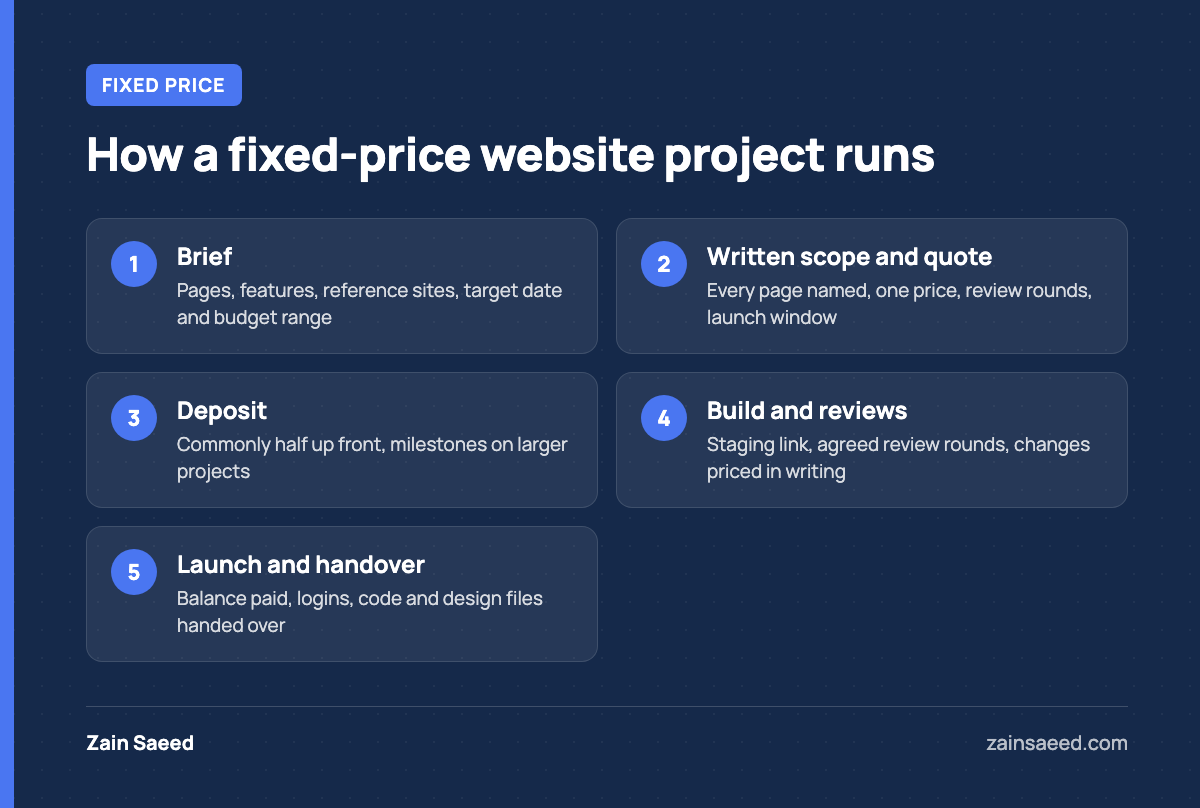
Expect these five things from any fixed-price website project:
- A written scope that names every page and feature before you sign.
- One total price and a launch window, with a deposit to start.
- A change process: anything outside the scope is priced and approved in writing before work starts.
- Clear client duties: content, feedback and access by set dates.
- Handover: on final payment you get the admin logins, the code and the design files.
The trade-off is simple. Fixed price works when you can describe what you want. If you can’t yet, pay for a short discovery or design phase first, then fix the price of the build.
Fixed price vs hourly
Both models are honest when used for the right kind of work. They just put the risk on different people.
| Fixed price | Hourly | |
|---|---|---|
| Total cost | Known before work starts | Known only at the end |
| Who carries overrun risk | The developer | You |
| Scope | Must be written in detail first | Can change week to week |
| Changes | Priced one by one as change requests | Added to the hours |
| Best for | Websites, stores, redesigns with a clear brief | Discovery, unclear apps, small ad-hoc tasks |
With hourly billing there is no ceiling, and every “while you’re in there” request quietly adds hours. With fixed price, the developer has a reason to finish on time with fewer revision loops, because extra hours are their cost. The catch is that the developer will only commit to a price when the scope is specific, which is why good fixed-price quotes take some back-and-forth before you sign.
What a fixed-price quote should list
If any of the items below is missing from your quote, ask for it in writing before you pay a deposit.
Deliverables, by name
Not “5–8 pages”. Every page and feature should be named, for example: Home, About, three service pages, Contact, a quote form with five fields, a reviews section on the homepage. Anything not on the list is not in the price.
Design
- Number of design rounds and what counts as a round.
- How design is delivered: mockups before the build, or built directly on a staging site.
- Fonts and colors agreed in writing before the build starts.
Technical setup
- Platform: WordPress, Shopify or something else, and why.
- Hosting, domain, DNS and SSL: who sets them up and whose account they sit in.
- Mobile layout: included, not an extra.
- Basic SEO and analytics: SEO plugin settings, titles and meta descriptions, GA4 and Search Console.
- Redirects if you are replacing an existing site, so old URLs don’t break.
Timeline with milestones
Kickoff date, first design or staging link, each review round, launch, and the end of the post-launch support period. Dates should depend on your feedback arriving on time, which brings us to client duties.
Client duties
- Content deadlines for copy, logo and photos.
- Feedback window for each review round.
- Access to hosting, the domain registrar and any existing site.
- What happens if a deadline is missed: usually the timeline moves, the price does not.
For reference, my own fixed-price packages are Starter at $1,200–$2,500 (2–3 weeks), Growth at $3,000–$6,500 (3–5 weeks), Premium at $7,000–$15,000 (5–8 weeks) and Enterprise at $15,000–$40,000+ (8–14 weeks). Each tier lists its pages, review rounds and support period, which is the level of detail you should expect from any quote. For market price ranges across US providers, see my US website design cost guide.
Payments, cancellation and ownership
Deposit and balance
A common split is half up front and half at launch. That is what I use for fixed-price builds. Larger projects are often split into three to five milestone payments tied to deliverables, so neither side carries too much risk at once.
Rule of thumb: be careful with any quote that asks for most of the money before you have seen a design or a staging link.
Cancellation
The contract should say what happens if either side stops. A fair version: either party can cancel in writing, and you pay for the work completed so far, measured against the fixed price. Avoid contracts that are silent on this.
Who owns the website
Don’t assume you own the code and design just because you paid for them. The U.S. Copyright Office explains that the person who creates a work is normally its author, and that a commissioned work counts as “made for hire” only in certain categories and with a signed written agreement (Circular 30, Works Made for Hire). So the contract should state in plain words that ownership of the site, code and design files transfers to you on final payment. Third-party themes and plugins stay under their own licenses. This is not legal advice; for a large project, have a lawyer read the ownership clause.
Also make sure the domain, hosting and any paid licenses are in your name, not the developer’s.
How changes and delays are handled
Two things break most fixed-price projects. Both are easy to manage if the process is written down.
Change requests
- You ask for the change in writing.
- The developer replies with a price and how many days it adds.
- You approve or decline in writing.
- If approved, it is added to the scope and the launch date moves. If declined, the project continues as planned.
This is not the developer being difficult. Without it, the developer absorbs the extra work, the project slows down and quality drops.
Content delays
Fixed-price timelines assume you deliver content on time. If the copy arrives three weeks late, launch moves three weeks too, and the price stays the same. The easiest fix is to have copy, logo and photos ready before kickoff.
When fixed price is the wrong choice
- Custom web apps: booking systems with complex rules, SaaS products, membership logic that is still being decided. These need discovery first.
- Migrations with unknown data: an old database nobody has looked at can’t be priced until it is audited.
- Ongoing maintenance: this suits a monthly plan, not a one-off price.
- Design exploration: if you don’t know the look you want yet, pay for that stage separately, then fix the price of the build.
To get a tight quote, send a brief with a one-line description of the business, the pages you need, your platform preference, three to five sites you like, a target date, a budget range, any special features and the state of your content. My guide on how to hire a website designer in the USA covers the questions to ask before you choose who to work with.
Frequently asked questions
Is fixed price always better than hourly?
No. It is better for well-defined builds like marketing sites, stores and redesigns. Hourly is better for exploration work where nobody can write the full scope yet.
What if the developer underestimates the work?
On a fixed-price contract, that is the developer’s cost, not yours. You only pay more if you approve a change request for work outside the written scope.
What is a normal deposit?
Half up front and half at launch is common. Larger projects are often split into milestone payments tied to deliverables.
Can I cancel halfway through?
It depends on the contract. A fair clause lets either side cancel in writing, with you paying for the work completed so far.
Do I own the website when it is finished?
Only if the contract says so. Ask for a clause that transfers ownership of the code and design files to you on final payment, and keep the domain and hosting in your own name.
If you want a fixed-price quote for your WordPress or Shopify project, send me a short brief and I’ll tell you what it will take.